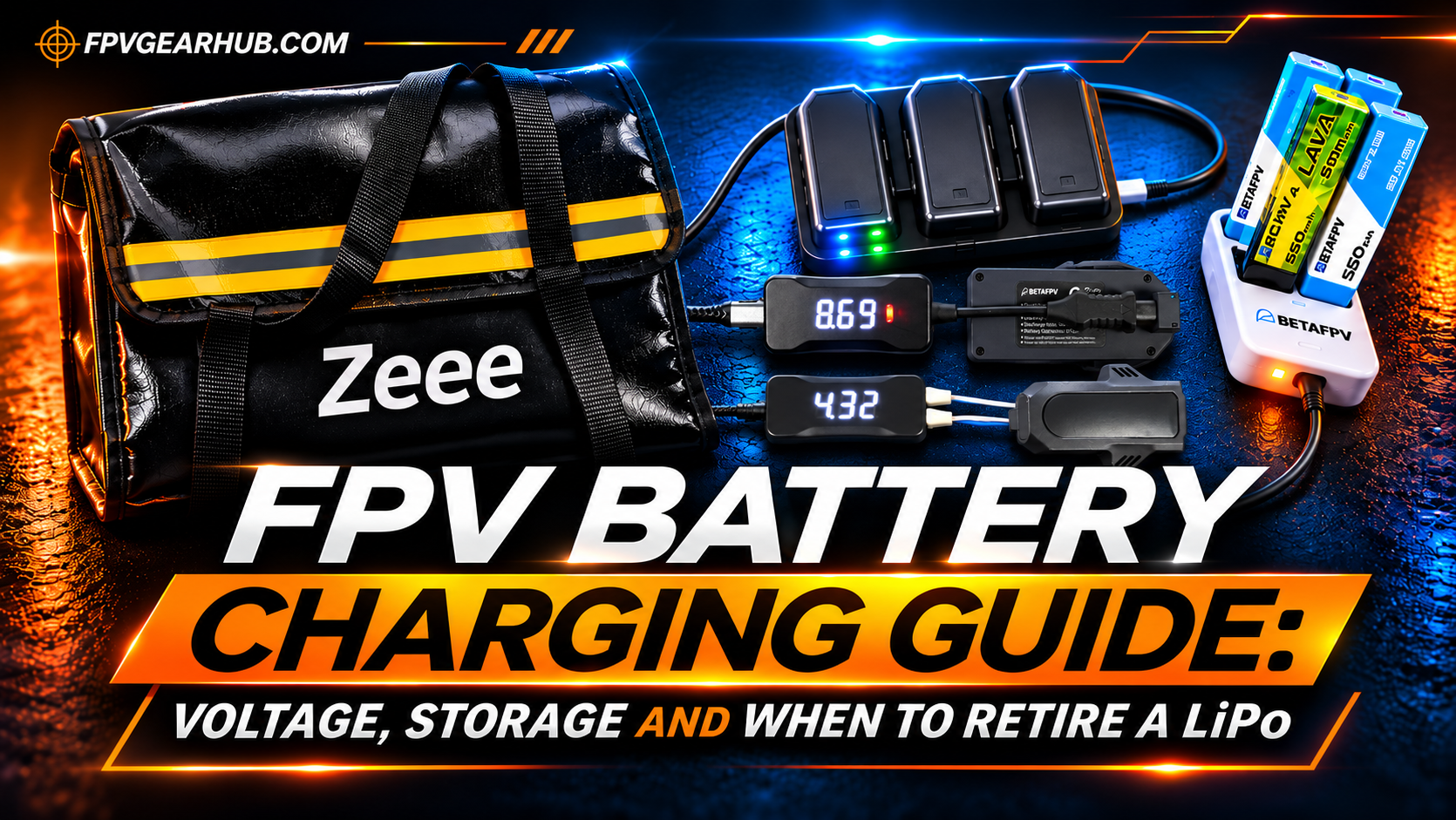
FPV Battery Charging Guide: Voltage, Storage and When to Retire a LiPo
FPV battery charging comes down to a few numbers. Charge 1S LiHV packs to 4.35 V (standard LiPo stops at 4.20 V), check voltage before every flight, store anything you won’t fly for a couple of days at about 3.8 V per cell, and retire any pack that puffs up. That’s the whole job. Below is how we do it with our own BETAFPV packs and chargers, with the readings we actually measured.
THE NUMBERS THAT MATTER
Full, standard LiPo: 4.20 V per cell
Full, LiHV: 4.35 V per cell (2S = 8.70 V)
Storage: about 3.8 V per cell (2S ≈ 7.6 V) if you won’t fly for 2+ days
Land and stop: don’t regularly run a pack below about 3.5 V resting
Puffy, dented or leaking: retire it, don’t charge it
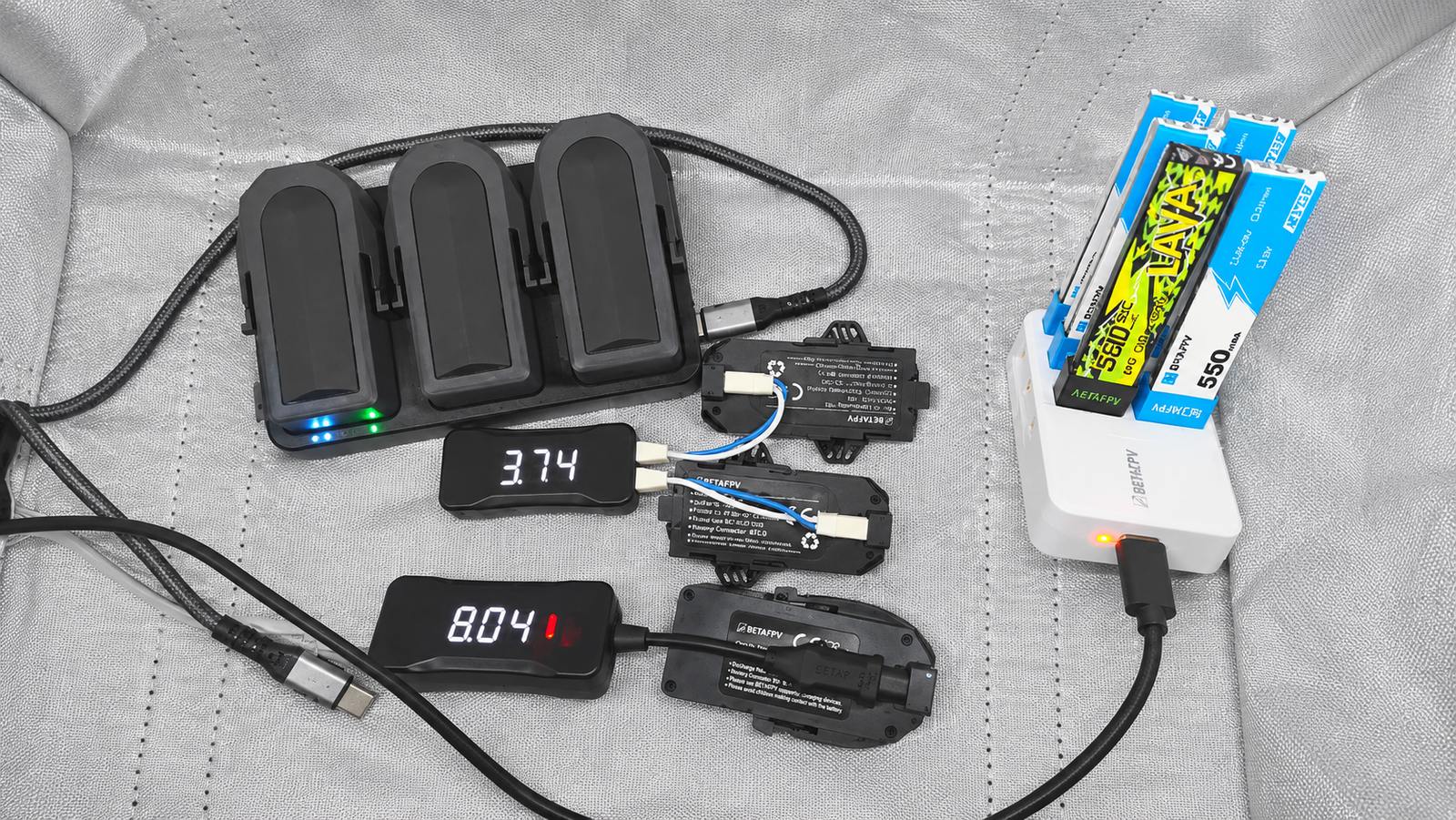
The batteries and chargers we use
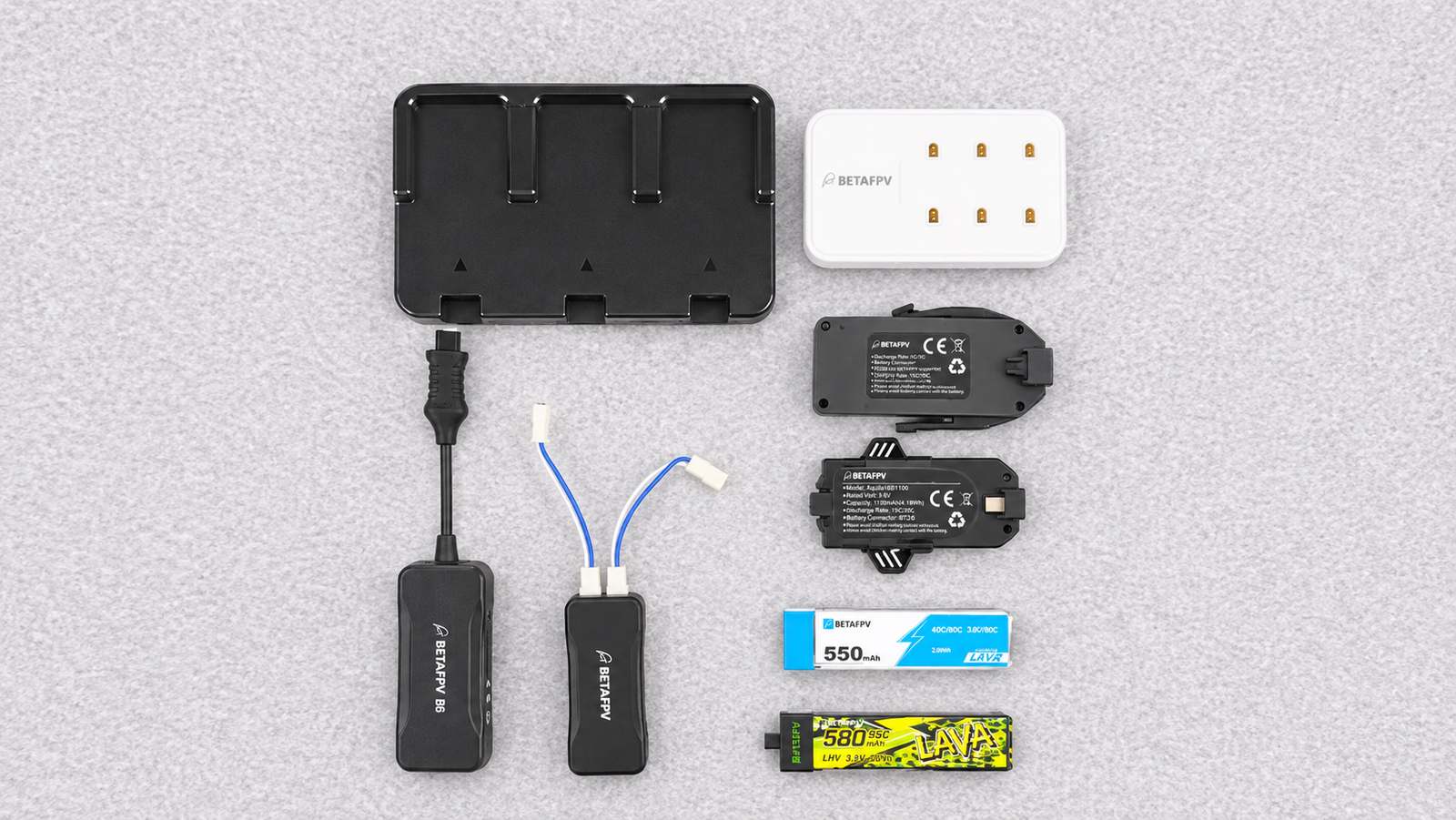
These are the packs and chargers that came with or alongside our beginner kits. If you own one of the kits in our best beginner FPV drone kits guide, you’ll recognise most of them.
| Pack | Cells / label | Capacity | Connector | Charges on |
|---|---|---|---|---|
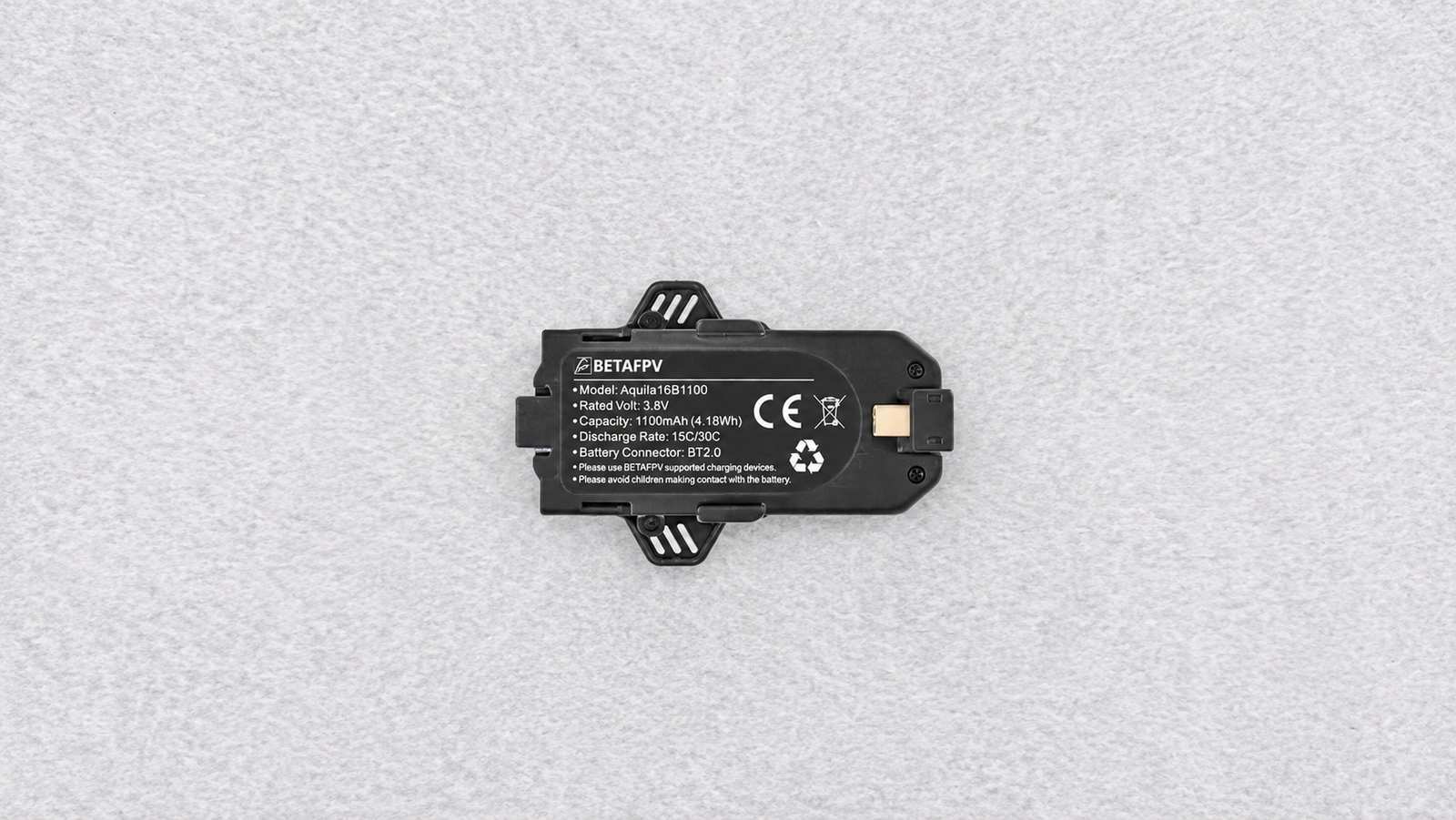
| Aquila16 battery (Aquila16B1100) | 1S, 3.8 V rated | 1100 mAh (4.18 Wh), 15C/30C | BT2.0 | BT2.0 charger/tester, 6-port 1S charger |
| Aquila20 battery (Aquila20B1100) | 2S, 7.6 V rated | 1100 mAh (8.36 Wh), 15C/30C | BT3.0 | BT3.0 charger/tester, Aquila20 Three-Way Charging Hub |
| LAVA 580 mAh | 1S LiHV, 3.8 V | 580 mAh (2.20 Wh), 95C | BT2.0 | BT2.0 charger/tester, 6-port 1S charger |
| BETAFPV 550 mAh | 1S, 3.8 V | 550 mAh (2.09 Wh), 40C/80C | BT2.0 | BT2.0 charger/tester, 6-port 1S charger |
LiPo vs LiHV: know what’s on the label
FPV packs come in two chemistries that look identical. A standard LiPo is rated 3.7 V per cell and is full at 4.20 V. A LiHV (high-voltage LiPo) is rated 3.8 V per cell and is full at 4.35 V. The rated voltage on the label is the giveaway: every pack in our kit is labelled 3.8 V per cell, and the LAVA spells out “LiHV”.
The charger has to match. Our BT2.0 charger/tester is labelled with a 4.35 V output, which is right for LiHV and too high for a standard 3.7 V LiPo. If you mix brands, check the pack’s rated voltage before you plug it in. A charger that tops a standard LiPo up to 4.35 V is overcharging it.
Check voltage before every flight
A ten-second voltage check tells you whether a pack is charged, whether it has been sitting too long, and whether one is starting to fail. The BETAFPV charger/testers double as voltage meters: plug a pack in and the display shows its voltage.
WHAT I MEASURED
Aquila16 1S pack, tested right after coming off the BT2.0 charger: 4.32 V (LiHV full is 4.35 V)
LAVA II 580 mAh 1S LiHV, same test: 4.28 V
Aquila20 2S pack on the BT3.0, near the end of its charge: 8.69 V (2S LiHV full is 8.70 V). When the charge finishes, the display switches from a number to a full-charge indicator.
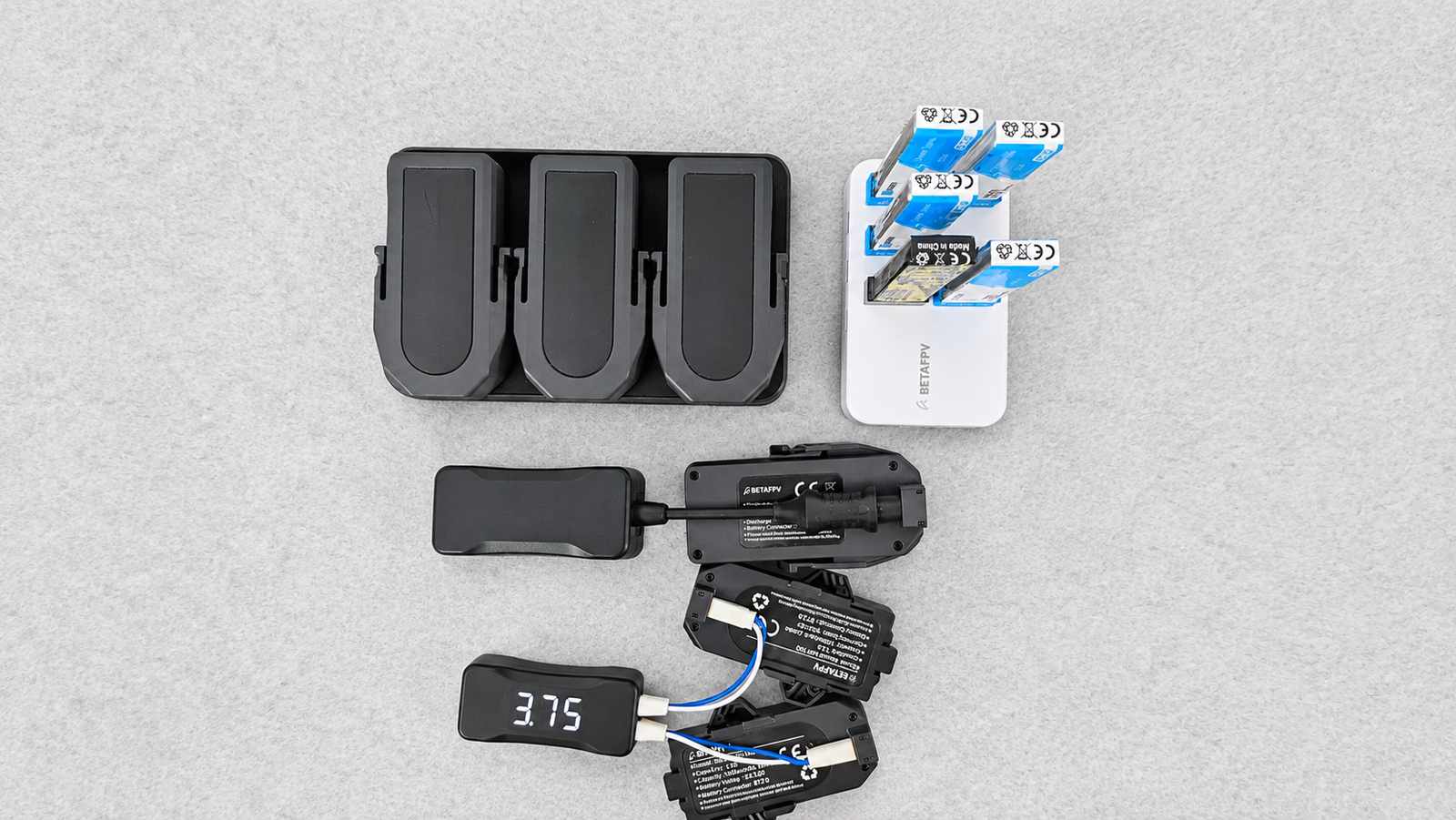
Two Aquila16 packs that had been sitting unused: 3.74 V and 3.75 V, right where you want them for storage
Flight time: about 8 minutes per Aquila16 pack in our own flying
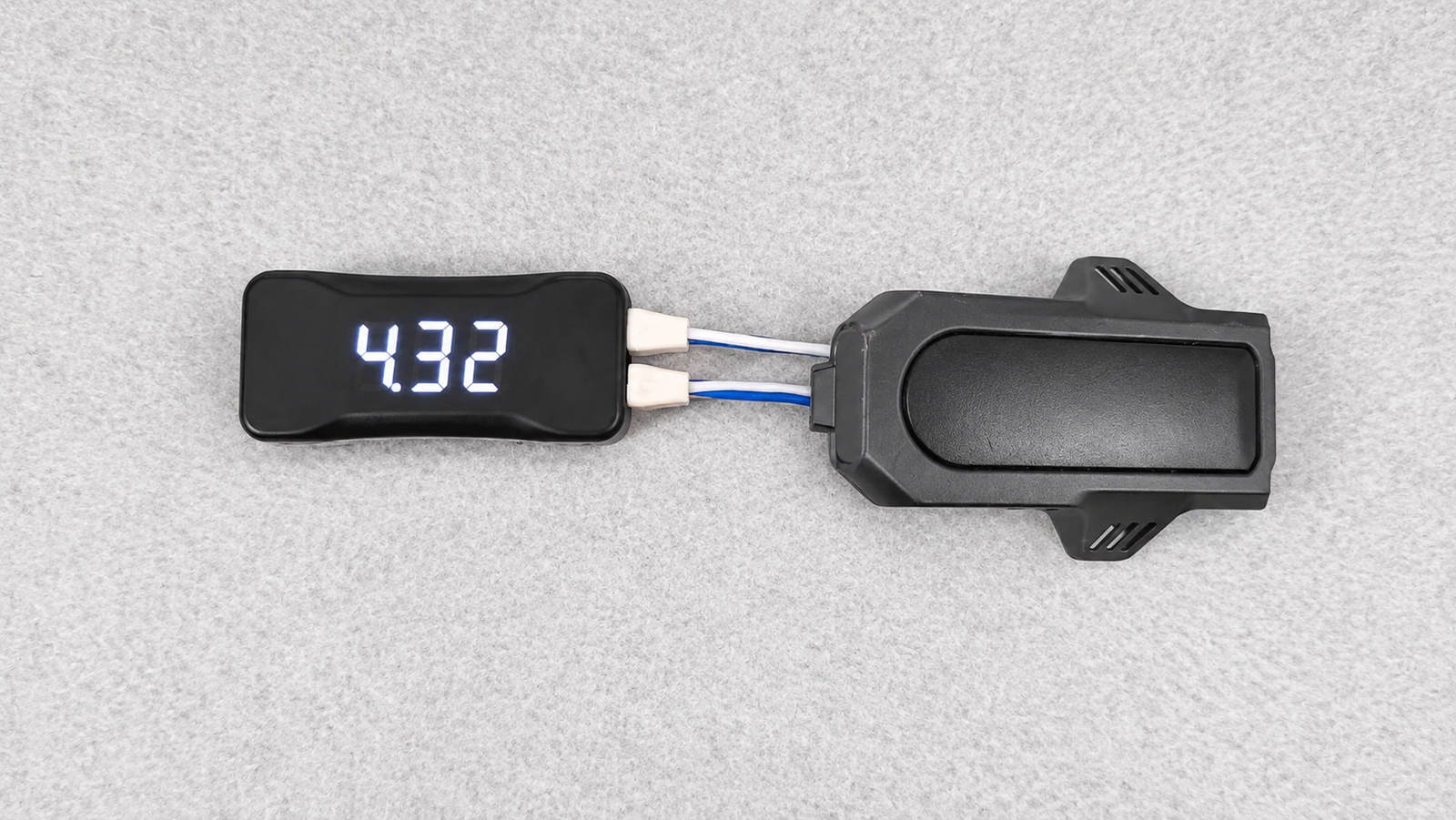

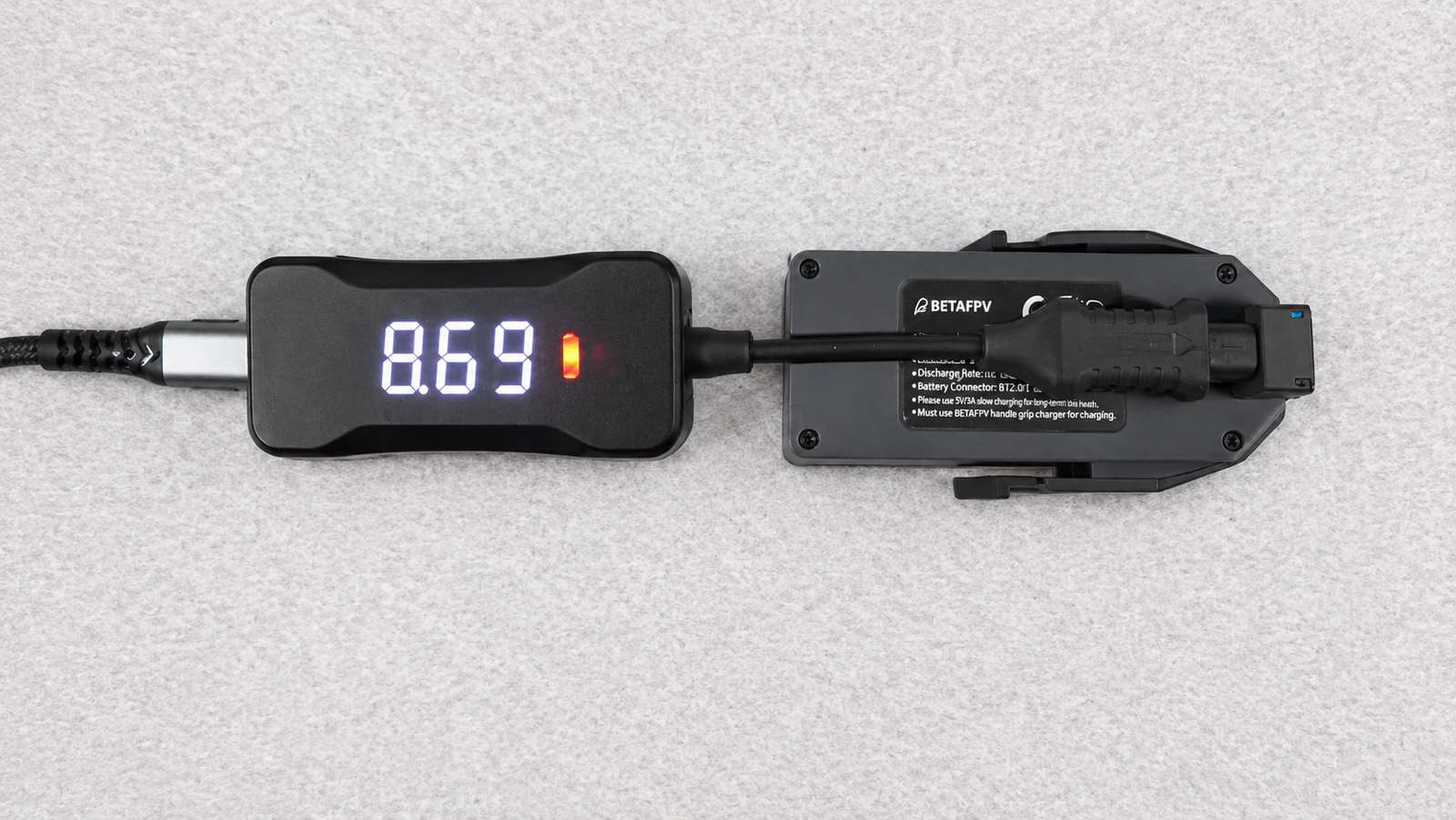
Don’t expect to see the exact “full” number. Our 1S chargers don’t show voltage while charging, so we unplug the pack and plug it into the tester. By then it has already settled a few hundredths of a volt below the 4.35 V the charger stopped at. That’s normal. Our Aquila20 charger never shows 8.70 V at all: it reads 8.69 V near the end, then switches to a full-charge indicator.
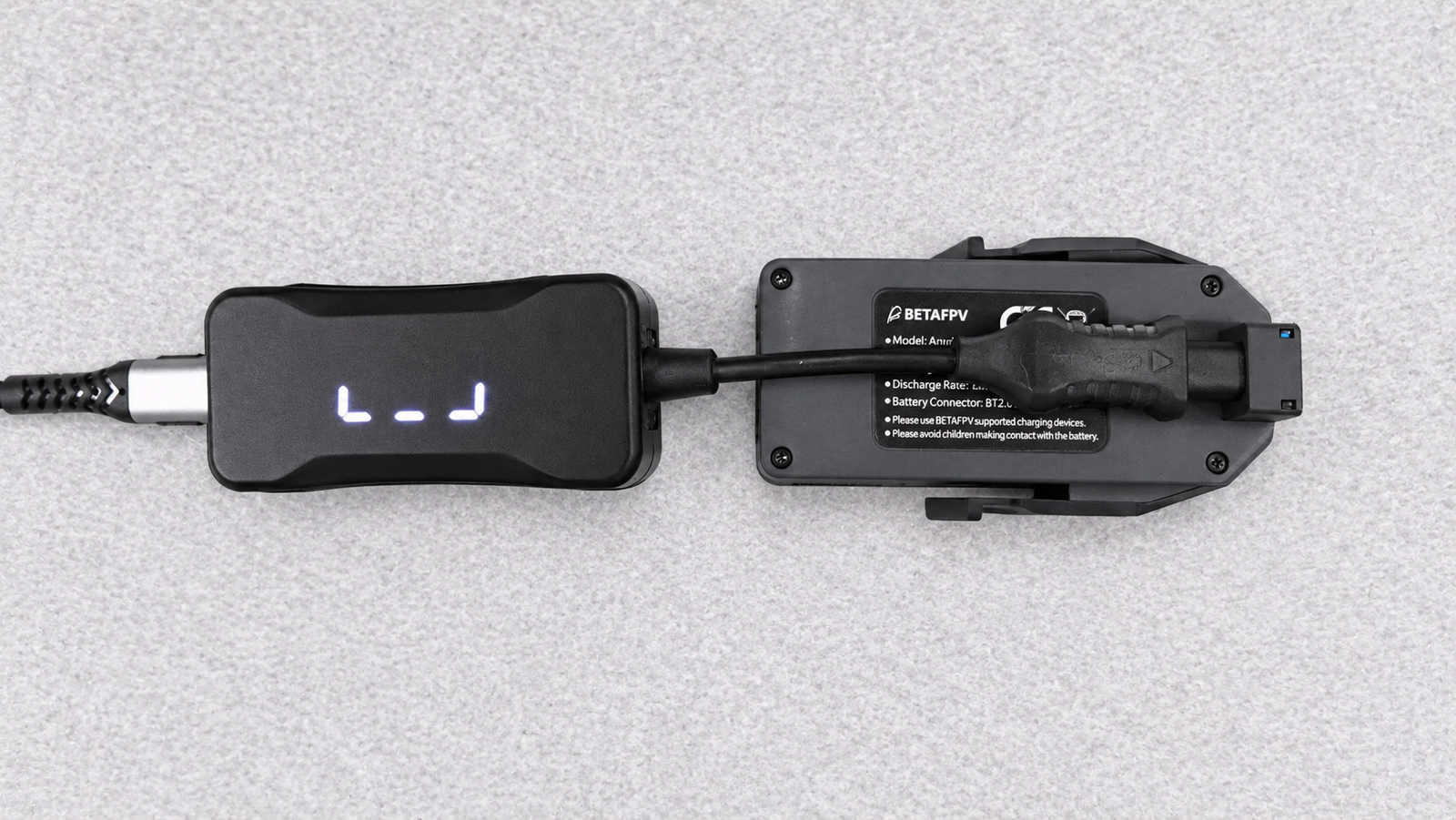
For a 2S pack, divide by two to get the per-cell number. What matters more than any single reading is the trend: note what your packs read after a full charge, and if one starts reading noticeably lower than the rest, or sags quickly in flight, it’s ageing. A stored pack that has dropped well below about 3.7 V per cell is also worth watching.
FPV battery charging, step by step
- Use the charger made for the pack. Match the connector (BT2.0 for 1S, BT3.0 for the Aquila20’s 2S packs) and the chemistry. BETAFPV’s own labels say to use BETAFPV-supported charging devices.
- Let a hot pack cool first. Packs come out of the drone warm. Give them a few minutes before charging.
- Charge in a LiPo bag, on a hard, non-flammable surface. Not on a bed, sofa or carpet.
- Never charge unattended. Stay in the room, and don’t leave packs charging overnight.
- Unplug when the charger shows full, then check the voltage before you fly.
That routine is the same whichever charger you use. The differences in FPV battery charging come down to the charger itself, so here is what each of ours does.
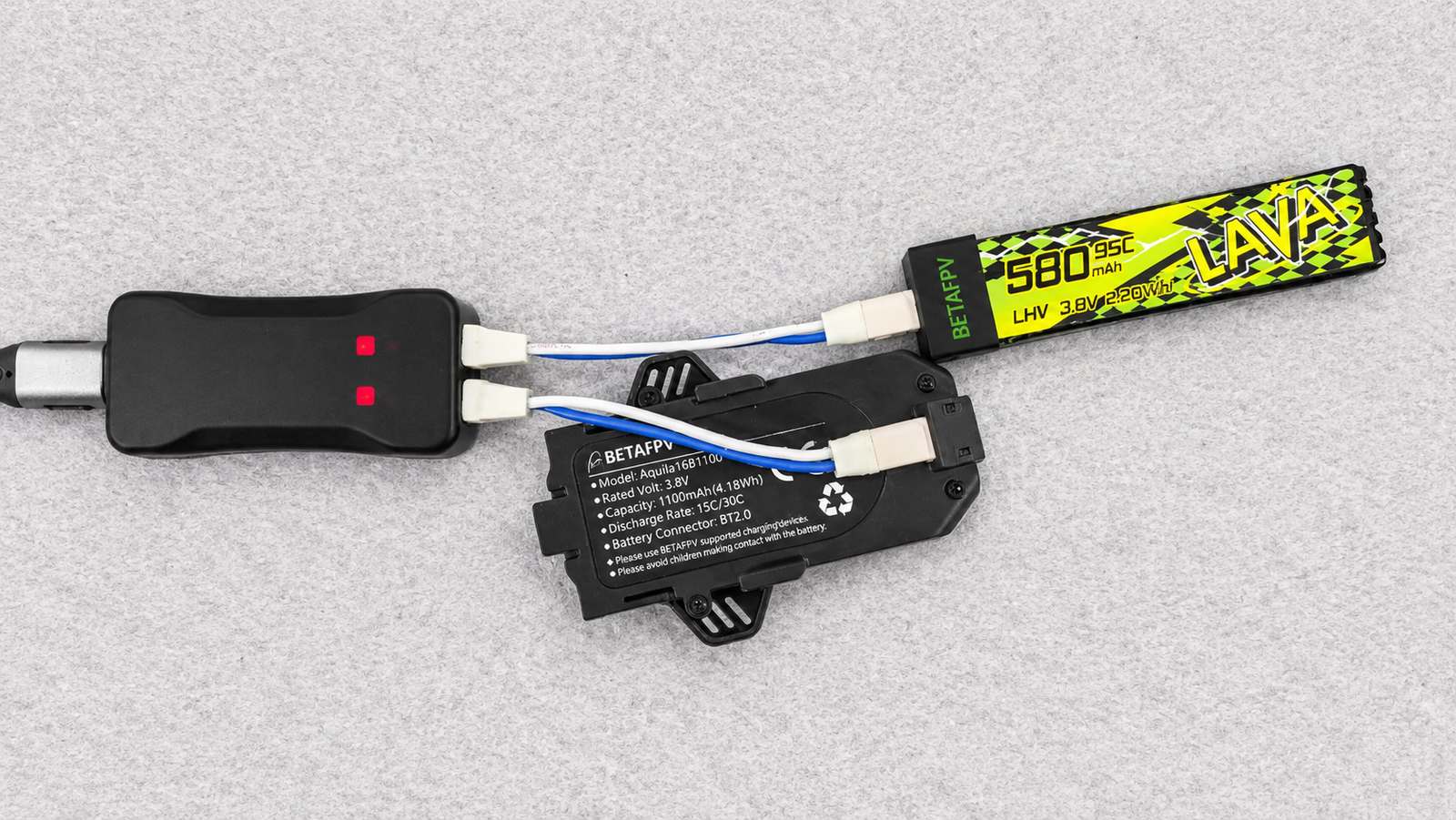
Our charger options, from the labels: the BT2.0 has two 1S ports (5 V / 2 A in, 4.35 V / 1 A out); the BT3.0 charges one 2S Aquila20 pack (7 V / 2.5 A in, 8.7 V / 1.5 A out); the Aquila20 Three-Way Charging Hub takes three Aquila20 packs (9–20 V in, 8.7 V / 1.8 A out, 15 W per port); and the 6-port 1S charger handles a full set of whoop packs at once.
Storage voltage: what to do when you’re not flying
A LiPo or LiHV that sits fully charged for days ages faster, and one left flat can drop too low to recover. The safe middle is about 3.8 V per cell (about 7.6 V for a 2S pack). If you won’t fly for two or more days, that’s where your packs should be.
Here’s the catch for FPV battery charging at home: none of our four BETAFPV chargers has a storage mode, as far as we can find. They charge to full and stop. So the practical routine is:
- Don’t top packs up “just in case.” Charge on the day you fly, or the night before.
- After a session, leave partly used packs alone and check them with the tester. A pack that landed around 3.7–3.8 V is already at storage level.
- If a full pack won’t be flown for a while, fly it down partway, then check that it’s near 3.8 V.
- Store packs in your LiPo bag, somewhere cool and dry, away from anything flammable.
- The Aquila20 packs have an on/off switch. Turn them off for storage so they aren’t left switched on.
If you’d rather have a storage button, that’s a feature of hobby-grade multi-chemistry chargers. For a beginner with a whoop kit, the routine above does the same job with the chargers you already own.
Puffy packs: when to retire a battery
A healthy pack is flat and firm. A pack that has swollen (“puffed”) has gas building up inside it, and it’s done. Don’t charge it, don’t fly it, and don’t try to squeeze it flat.
Retire a pack if:
- It’s swollen, soft or puffy, even slightly
- The wrap is torn, the pack is dented or punctured, or it leaks
- It gets unusually hot in normal flying or charging
- The connector or leads are damaged
- It won’t hold a charge: it reads low straight off the charger, or your flight times have dropped noticeably
Move a damaged pack into your LiPo bag, outside or on a non-flammable surface, away from anything that can burn, until you can dispose of it properly.
How to recycle FPV batteries
Never put LiPo or LiHV packs in the trash or curbside recycling. Lithium batteries that get crushed in garbage trucks and sorting facilities start fires.
- Healthy, used-up packs: take them to a battery drop-off. The Battery Network (formerly Call2Recycle) runs free drop-off points at retailers including Best Buy, The Home Depot, Lowe’s and Staples. Find one with their drop-off locator.
- Tape or bag every pack first. Cover the connector with clear packing, electrical or duct tape, or put each pack in its own clear plastic bag.
- Swollen or damaged packs are different. The Battery Network says a lithium-ion battery that is swollen, leaking, overheating or punctured needs special packaging and handling and can’t go in the regular drop-off box. Contact them or your county’s household hazardous waste facility for instructions.
Flying with FPV batteries
If you travel with your kit, spare lithium batteries go in your carry-on, never in checked bags. Every pack on this page is far below the 100 Wh limit that needs airline approval (the biggest, the Aquila20 pack, is 8.36 Wh). Tape or cover the connectors and carry them in your LiPo bag. The FAA’s PackSafe lithium battery page has the current rules.
The gear on this page
All BETAFPV links go to BETAFPV directly. Check the connector matches your drone before you buy.
Spare packs
Aquila16 1S battery at BETAFPV → Aquila20 2S battery at BETAFPV → LAVA II 1S battery at BETAFPV → 550 mAh 1S battery at BETAFPV →Chargers and testers
BT2.0 charger/tester at BETAFPV → 2S (BT3.0) charger/tester at BETAFPV → Aquila20 3-way charging hub at BETAFPV → 6-port 1S charger at BETAFPV →LiPo bag

Frequently asked questions
What voltage is a fully charged FPV battery?
A standard LiPo cell is full at 4.20 V; a LiHV cell is full at 4.35 V. Multiply by the cell count for bigger packs, so a 2S LiHV pack is full at 8.70 V. Expect a few hundredths less once a pack comes off the charger: our Aquila16 read 4.32 V and our Aquila20 read 8.69 V near the end of its charge.
What is LiPo storage voltage?
About 3.8 V per cell, or about 7.6 V for a 2S pack. Store packs there if you won’t fly for two or more days. Our BETAFPV chargers have no storage mode, so fly a full pack down partway or leave a partly used pack as it is, then confirm with a voltage tester.
Can I charge a regular LiPo on a LiHV charger?
Not if the charger only charges to 4.35 V. That overcharges a standard 3.7 V LiPo, which should stop at 4.20 V. Check the rated voltage on the pack (3.7 V = LiPo, 3.8 V = LiHV) and the output voltage on the charger before plugging in.
Is a puffy LiPo battery safe to use?
No. A swollen pack is damaged. Stop using it, don’t charge it, keep it in a LiPo bag on a non-flammable surface, and arrange disposal. Swollen batteries need special handling and shouldn’t go in a regular battery drop-off box.
How do I recycle old FPV batteries?
Tape the connector or bag each pack, then take healthy used packs to a free drop-off run by The Battery Network (formerly Call2Recycle), such as Best Buy, The Home Depot, Lowe’s or Staples. For swollen or damaged packs, contact The Battery Network or your local household hazardous waste facility first.
Battery check done? Run the rest of your preflight.
Our free FPV preflight checklist covers the battery check plus everything else to run through before you arm.
Get the FPV preflight checklist →New to all of this? Start with what FPV actually is, then pick a kit from our best beginner FPV drone kits guide.